Nothing you learn disappears silently

Konku holds your notes and cards, then works out for itself when each card needs reviewing. The name comes from Konsisten-ku, "my consistency", and that is also the whole idea: small consistency beats occasional intensity.

New accounts are not open yet. There is no waiting list — when signup opens, the button on this page is what changes.

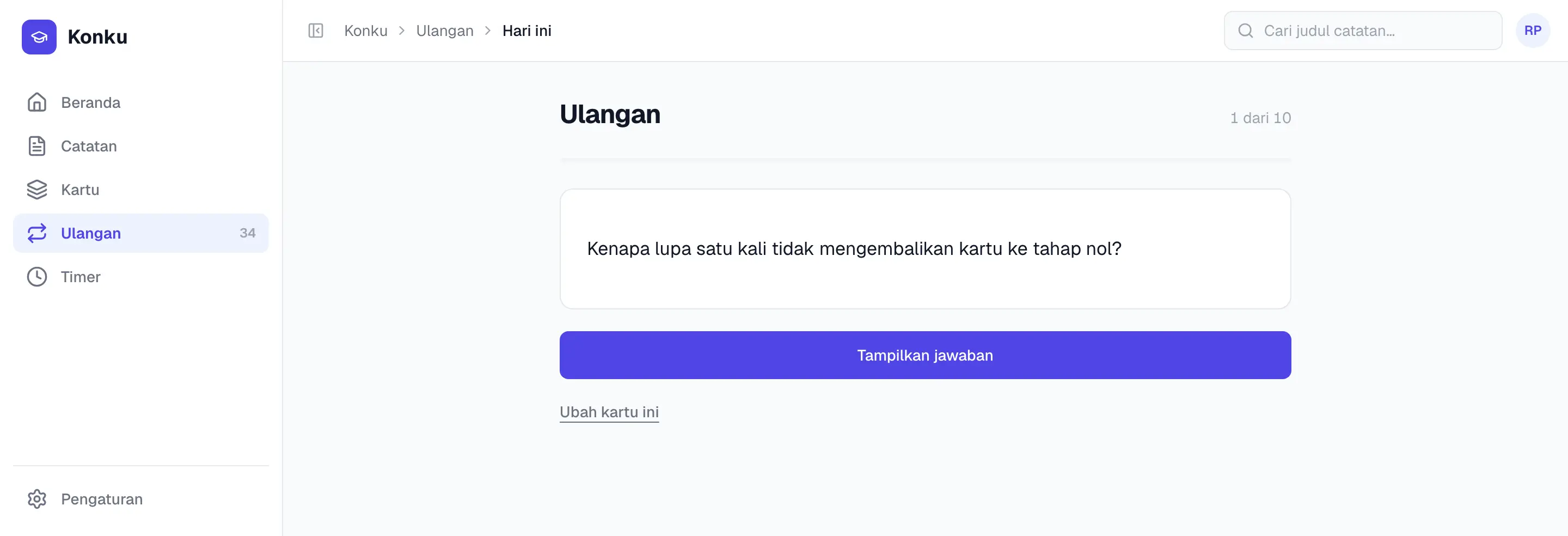
The Konku review screen: one question is shown, its answer still covered, with a button to reveal it.

The problem

Quick to understand, quick to forget

Memory fades on a schedule of its own, and that schedule does not care how clear something felt the first time you understood it.

What goes missing rarely feels missing — you usually find out when you need the material again.

Keeping track of what to review and when is not a question of discipline, it is bookkeeping. Bookkeeping is work for software.

How it works

Write, make cards, review

Three steps, and the third one is not yours to remember.

  1. 01

    Write a note

    Markdown, a title and a body. One domain per note, and as many categories as you need. No wizard and no type to pick up front: a blank page and a cursor.

  2. 02

    Make cards

    Cards are their own feature, not something parsed out of a note: you write the front and the back yourself. Cards and notes share the same domain and categories, so the same filters reach both.

  3. 03

    Review what is due

    Open Review, work through what comes up that day, done. You never pick which cards to review: the scheduler picks, and a schedule cannot forget.

The interval ladder

A new card is due tomorrow. Each time you remember it, the gap moves up one rung. Each time you forget, the card goes back to tomorrow — that is all, no other penalty and no history lost. Past the last rung, a card stops being scheduled and is marked as mastered; its history stays.

Days between reviews.
  1. 1
  2. 3
  3. 7
  4. 14
  5. 30
  6. 90
  7. 180

Deliberate limits

Four things Konku refuses to do

Every spaced repetition app has a feature list. What tells them apart is what is missing from it — and these four are missing because they were decided against, not because nobody got round to them.

  1. The daily queue stops at ten cards

    Ten cards a day, longest overdue first, the rest moved to tomorrow without any fuss. The screen says only that the rest are tomorrow. Coming back from two weeks away to forty due cards is not a challenge, it is a reason to stop — and however tidily that number is presented, it is still the number that makes people give up.

  2. The answer is not sent with the question

    When a card comes up, the server does not send its back at all. Not hidden with CSS, not a habit of the interface — the API response genuinely carries no answer until you press reveal. Recall you can peek at in dev tools is not recall, and recall is the one thing that makes reviewing worth anything.

  3. There is no streak to lose

    No points, no badges, no levels, no run of days that resets because you missed one. A missed day is normal and the app treats it as normal: what is due keeps waiting, nothing is forfeited, nothing tells you off. Mechanics built on guilt make people stop, not keep going.

  4. No social side at all

    No sharing, no leaderboards, no friends, no way for anyone to see your notes. Learning history is never pooled across accounts into statistics either: every number is worked out per account, for that account. It is the most useful data this product could gather, and that is not a reason to gather it.

What's inside

Five screens, all of them built

Today's review

One queue, already ordered, ready to work through. You answer from memory first, then reveal the answer, then mark it remembered or forgotten. There is nothing to set up before you start — one click from the home screen to the first card.
Markdown notes

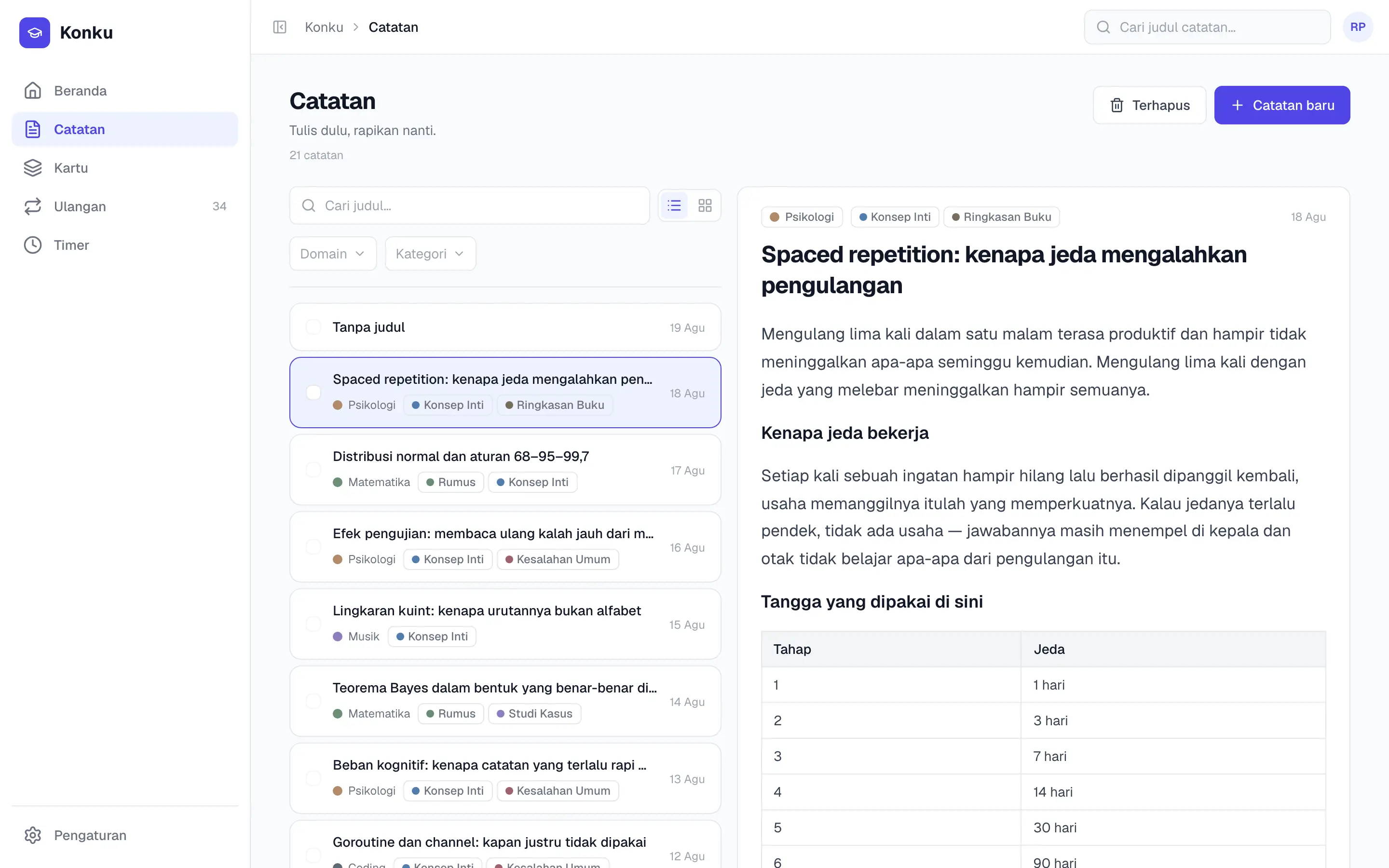
A title and a body, written in markdown. One domain per note and as many categories as you need, with filters that can combine several domains and categories at once. Title search runs on the server, so "nothing found" means there is nothing, not that it has not loaded onto the screen yet.

The notes page: the list column on the left, a preview of the open note on the right.
List view. The toggle above it switches to grid.

Cards, a feature of their own

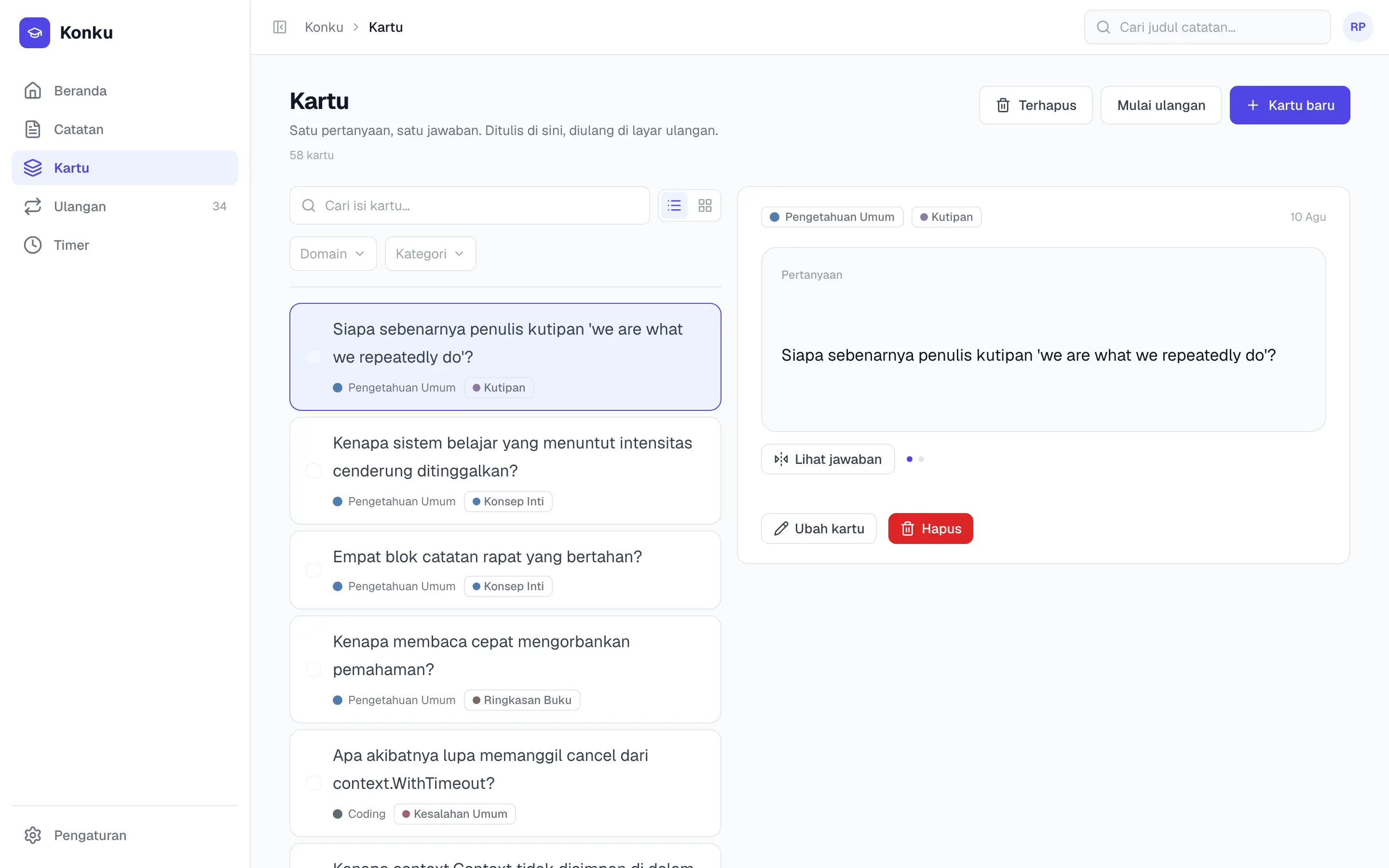
Cards are not taken from notes — you write them directly, front and back. Editing a card's text never resets its schedule, so fixing a typo does not throw away months of review history.

The cards page with one card open, showing its front.
The card preview turns over and back again. This is a preview, not a review session.

Focus timer

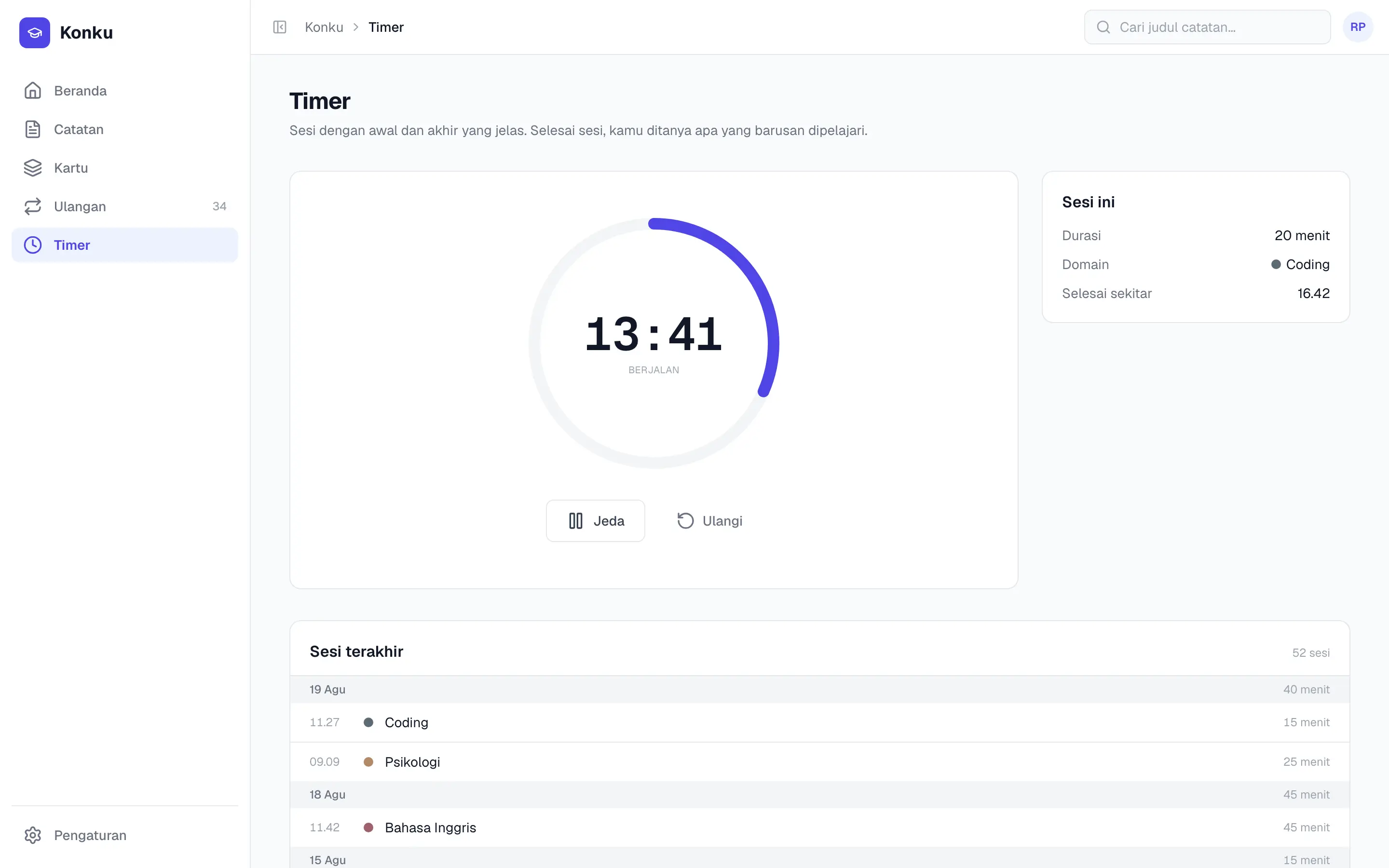
15, 20, 25, 30, or 45 minutes, with 20 as the default — a short session you finish is worth more than a long one you walk away from. A session can be given a domain from the start, or not. When the time is up, one question appears, asking what you learned. One field, and you can skip it.

The focus timer running, with the time remaining in the middle of the screen.

Practice sets you put together yourself

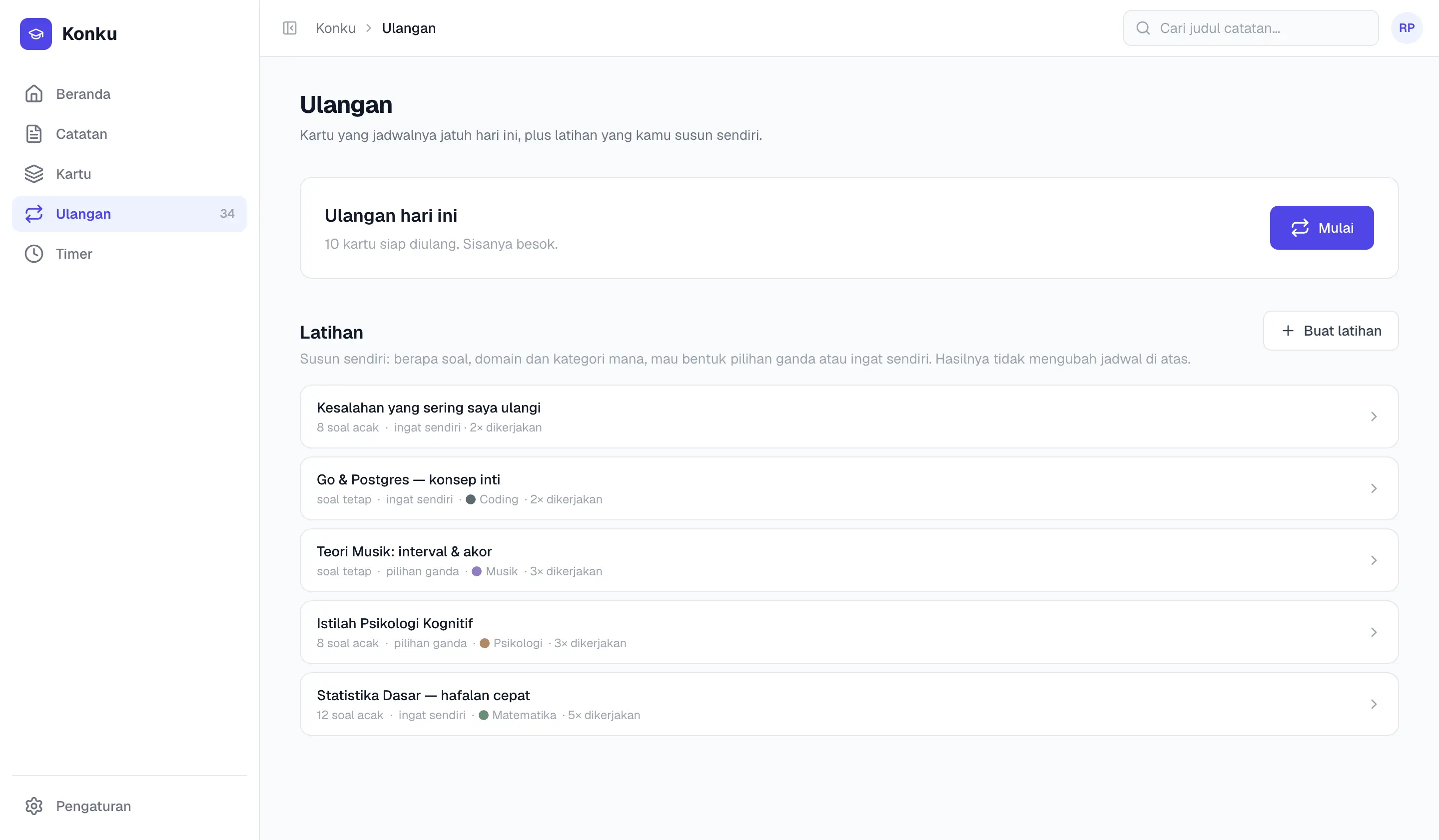
Save a practice set along with its filters: which domains, which categories, how many questions, a fixed set of cards or a random draw, free recall or multiple choice. A practice set can be left half-done and picked up later. Answers in a practice set never move your review schedule, so no amount of practice breaks anything.

The Review page: today's queue at the top, the list of saved practice sets below it.

Your data

Yours, and you can take it with you

Export everything
One request produces an archive holding everything in your account: notes and cards as markdown files that stay readable in any editor, the rest as JSON. No queue, and no permission to ask for.
Delete your account whenever you like
Deleting your account removes everything it owns in a single statement. Not a deactivation and not a tombstone — the rows are gone. It is the one action in the app that asks for your password again.
Not sold, not tracked
No ads, no third-party trackers, no cross-account analytics. What you delete does not quietly linger either: notes and cards go to Deleted first, can be brought back for 30 days, and are removed for good after that. Cards you have reviewed are kept indefinitely.

Small consistency, every day

Konku is free, run by one person, the code is open, and it works in Indonesian and English. If that is how learning goes for you — understand quickly, forget quickly — this is what it was built for.

Log in